WE HAVE BEEN DOING LAYAWAYS ON A LIMITED BASIS BUT DUE TO THE ECONOMY NOW WE HAVE DECIDED TO OFFER THE LAYAWAY OPTION TO EVERYONE. OUR TERMS ARE 25% OF THE TOTAL PURCHASE DOWN WITH THE OTHER 75% PAYABLE IN 3 EQUAL MONTHLY PAYMENTS OF 25% OF THE INITIAL BALANCE. NO PENALTY FOR USING YOUR CREDIT CARD EITHER. CHECK THE INDEX PAGE FOR COMPLETE DETAILS. THANKS!
WE WILL NOT SELL OR SHIP FIREARMS OUT OF THE USA & EVERY ITEM COMES WITH A 3 DAY INSPECTION PERIOD. I AM NOT A FIREARMS EXPERT OR A GUNSMITH BUT WILL DO THE BEST I CAN TO DESCRIBE THE DIFFERENT WEAPONS. PLEASE E-MAIL QUESTIONS AND I'LL DO MY BEST TO ANSWER THEM IN A TIMELY FASHION. THANKS!
THE NEW, ENLARGED 9th EDITION FOR 2008 ! FLAYDERMAN’S GUIDE TO ANTIQUE AMERICAN FIREARMS...and their values.
THIS NEW 9th EDITION IS NOW IN STOCK AND AVAILABLE FOR IMMEDIATE SHIPMENT at only... $39.99. Free shipping within continental limits of the U.S.
Increased over 20% in size, it now numbers over 800 pages... with over 1200 revisions, up-dates, new models and variations... and even more illustrations!
It’s the one book about antique arms collecting that the dealer, trader, collector or merely casually interested cannot do without. Includes all the basic tools for identifying, valuing & collecting antique American firearms
Celebrating its 30th year as the acknowledged "Bible" for antique arms collectors and with over one million copies already in circulation this new 9th Edition tops them all!
With values for over 4,000 individual antique firearms (c. 1750-1914) and 1900 photographs, the collector is certain to find this latest issue the best yet and one that lives up to its long-established reputation as "...quite simply the best and most important study of antique American arms ever written" (Man-at-Arms Magazine) and "Indispensable" (The Gun Report).
Unanimously acclaimed by the critics and reviewers as among the most complete and thorough arms books extant, it ranks as the most comprehensive book on antique gun collecting ever produced!
Included are individual chapters on every major American arms maker all lesser makers are listed by type, such as: American Percussion Pistols (Classified by: Revolvers Pepperboxes Single Shots Deringers Underhammers.). Separate chapters on American Metallic Cartridge Handguns (one of largest in the book) Confederate Arms; Kentucky Rifles; Single Shot Rifles (Muzzle Loading and Breech Loading) Colonial and Rev. War Arms Repeating Rifles. The chapters on U.S. Military Longarms and Military Single Shot Pistols alone are worth the cost of the book. The American Shotguns chapter is the first in-depth coverage of them, while Chapter 18 individually covers (and values) 8 categories of antique American arms seldom mentioned or discussed in any guide: American Whaling Guns; Indian Trade Guns and Indian used guns; Alarm Guns; American Blunderbusses; early American Spring and Air Guns; and even Salute and Yacht Cannons.
For the American historian, folklorist and general antique arms collector, the new chapter on DUELING AND DUELING PISTOLS is certain to raise some eyebrows with its Incursions On Virgin Territory in which the author has actually thrown down the gauntlet and fired the very first salvo to question and provide a logical rationale for understanding the fascinating subjects of dueling in early America and the pistols said to have been specifically designed for that gentlemanly practice.
AND THAT’S NOT ALL new inroads are made to recognize the very history of American arms collecting itself. Other relevant discussions new to this edition assess the increasing influence of antique firearms auctions to this hobby; a new section on the history of antique arms periodicals and publications and their impact on the hobby; and for the first time anywhere, a history of the very first American antique firearms collection and catalog (1899) of the famous A.E. Brooks Collection of Hartford, Conn. and its subsequent exhibition in 1906 by the Smithsonian Institution and its later adversities.
Perhaps the words of Mike Carrick, Staff Editor of the "Questions and Answers" columns of the Gun Report magazine said it best. Fielding a heavy volume of inquiries about antique arms on a daily basis he wrote: I have over 2500 books on guns and edged weapons, but I have only [Flayderman’s Guide] on my desk for constant daily use in answering my column’s inquiries it is the most useful book in my library."
The first one is a very nice marked double barreled percussion shotgun being marked P. Powell & Sons and being about 45 1/2 inches long. P. Powell was a maker out of Cincinatti, Ohio in the mid to late 1800's. He was around and making guns during the Civil War. This one is in great condition with a wonderful patina just missing the wooden ramrod. The action works fine but one of the nipples is banged up a bit however the hammers are a match. The walnut stock is in great original condition with no cracks. There is a steel butplate present. There is the usual pitting around the nipples from being used. This old girl must have delivered quite a whopping recoil when fired! Nice old piece! $325.00


Here we have picked up an Islamic Ottoman Decorated Dagger from 1700 to 1800 AD. This gorgeous Islamic single edged weapon has its metal handle, and blade profusely decorated with foliage in intricate whorls, and stylized gazelles on each side of the blade and handle, as shown. The pattern is engraved identically on both sides of the blade and handle. The wooden part of the handle is a later addition, probably 19th-20th century. Overall a rare and very well made museum quality late medieval single edged weapon. This hacking dagger was originally purchased from a German auction house. Intact, untouched. Old English collection. Length of dagger: 17 inches. The Ottoman Empire was established by the cruel killing nature of the Mongoloid races invading into Southern Europe and "ruleing by the sword". This is one such example of an infamous albeit very attractive single edged cutting weapon! It looks like the tip was used to pierce armour. This is a very impressive piece and comes with our guarantee that it is what we profess it to be. We also have a certificate of authenticity from the original English Dealer that we purchased it from. You don't often see these weapons in any condition! $450.00
Here we have a small hand ax. I don't know if this small of a hand ax could have been used for a weapon-I suppose it could have- but I do know that during the Revolutionary War these small axes were used to butcher small game animals which were shot on the trail. One similiar is pictured in 'COLLECTORS ILLUSTRATED ENCYCLOPEDIA OF THE AMERICAN REVOLUTION' by Neumann and Kravic on page 161. It's written there that the one pictured is 9 1/2 inches long. Our's is 10 3/4 inches long with a 3 1/2 X 2 inch head. There is a groove cut into the end of it to secure a laynard to the handle. The laynard would then be slipped over the wrist to keep from dropping the ax. This is a nice piece and has some original red paint on the head still left. I don't believe this is as old as the Rev war period-perhaps Civil War era. Nice little piece! Forged head with oval eye. No makers marks. $65.00
I also procured a small ax head with the above ax that has had the handle broken out of it. This head is exactly like the head above and is the same size as the head above as well. Just needs a handle to be complete. Unusual small size! $25.00

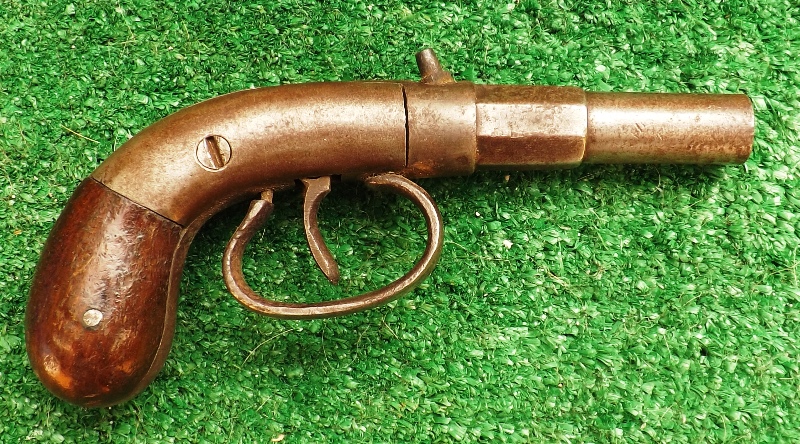
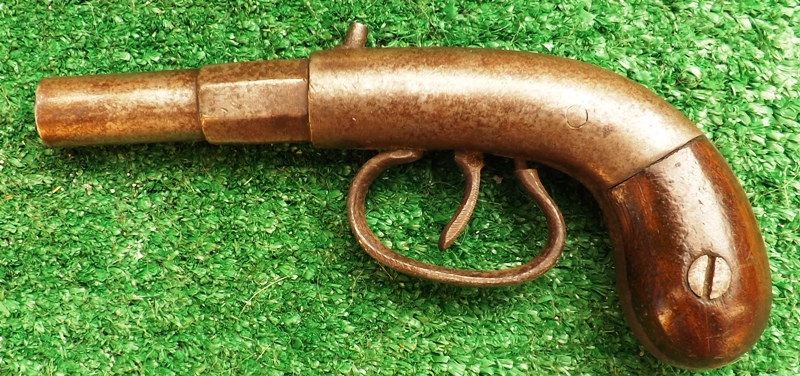
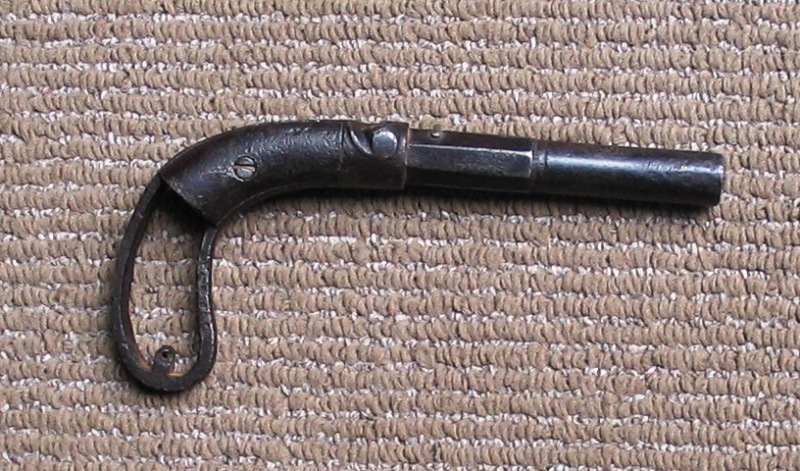
Here's a little dandy that I just picked up here in Indiana. This is the variant small brass frame type Bacon Mfg Co. Single Shot pistol in 32 caliber. This piece has the 3 5/8ths inch octagon barrel. This octagon barrel pivots to the right for loading a 32 caliber short cartridge. This piece has no markings except for the serial number of 3758. They were made from the early to mid 1860's. This piece has a spur trigger with walnut grips that have a square butt. There area a couple of minor dings to the edge of the grips but not bad at all. This weapon functions flawlessly and looks great! Flayderman's states that the bass frame variants are known and are rare bringing premium values. In fine condition this piece is valued at $725. The brass frame on this piece has a nice mellow color. The bore is dark. Nice, Nice piece and the rarer type! $495.00
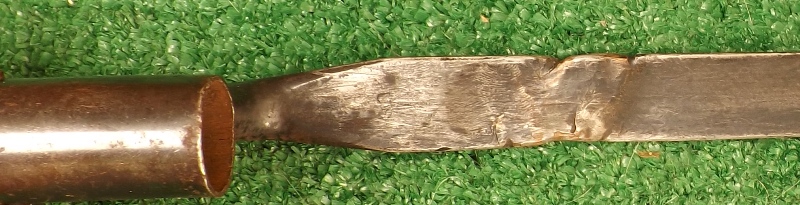
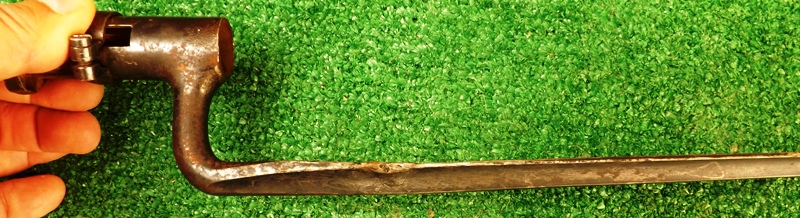
This is an Austrian Lorenz 4 sided Bayonet for the Civil War Model 1854 Lorenz. This bayonet had been plated at one time. This was probably done by the old veterans who paraded with their old Lorenz with gleaming bayonet down Main Street in all of their former spendor! It still a nice piece and you may be able to clean it up better. From Central Indiana. $75.00
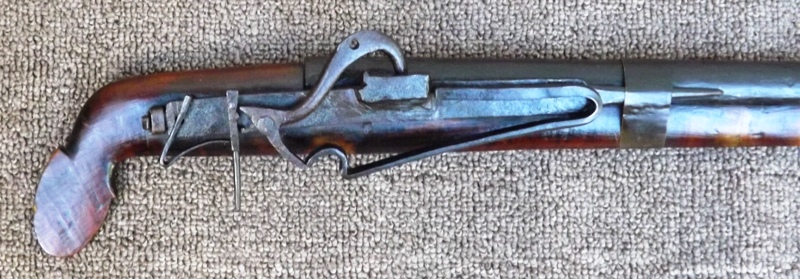
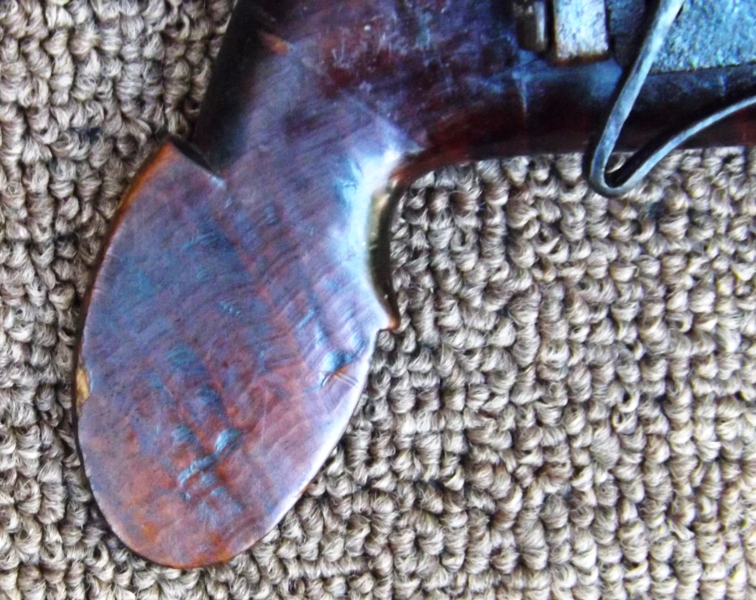
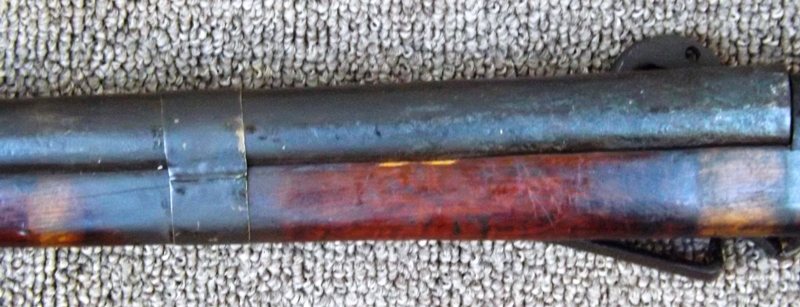
Here is a rare Belgian Single Shot 12Ga Pin Fire Shotgun. You find the double barrel pinfire shotguns but almost never the single shots! This antique shotgun is in the bright with just a little surface rust which will clean off without leaving any pitting. The lock works properly but the locking lever is loose and doesn't cam down and tighten the barrel properly. If this were fixed the lockup would be tight and I sure a good gunsmith could do the job. The toe of the stock has been repaired. There is wood missing above the front part of the lock. The bore has some scattered pitting. There are no maker's marks. The action works great! It's a looker! This piece is from California. $375.00
Here's a pretty little 28 caliber single shot percussion pistol. There are no markers marks on this little gun, only the serial number of 185 so we know they made at least that many of this pistol. The action works very well and is tight. The little walnut grips are in fine condition as well. This is a great little boot or vest pistol! $225.00
Here's a unique old sideknife that I recently picked up an old 19th century Civil War / Indian Wars era or earlier side knife from California. This blade has the classic "clip point" and is 1" at it's widest point. Handle is made of horn and exhibits great age. Hilt area is wonderful patinated brass. Blade is overall dark gray steel with some mottled color. No active rust or deep pitting is present. Interesting brass military looking screw type washer is screwed on to base of handle. Looks to be hand forged blade. Overall length is approx. 11.25" with a blade length of approx: 6." A very neat looking blade and heavy! $295.00
This next item is a wonderful combination pocketknife/fork tool. This piece measures 3 3/4 inches closed and 6 1/2 inches in the open position. When opening the fork to half position the two pieces seperate to form 2 separate eating utensils! The grips are black bone. The Blade has been recently cleaned but luckily the marks on the blade have not been compromised. One one side of the blade located on the ricasso it is marked Sheffield Make and on the other side it is marked J.G.Graves - Sheffield. When the parts are separated the same part number of P76939 is stamped on both pieces. Most of the knifes imported into the US and the CS during the 'Late unpleasantness' were English made. This piece was found in Catskill, New York. $225.00
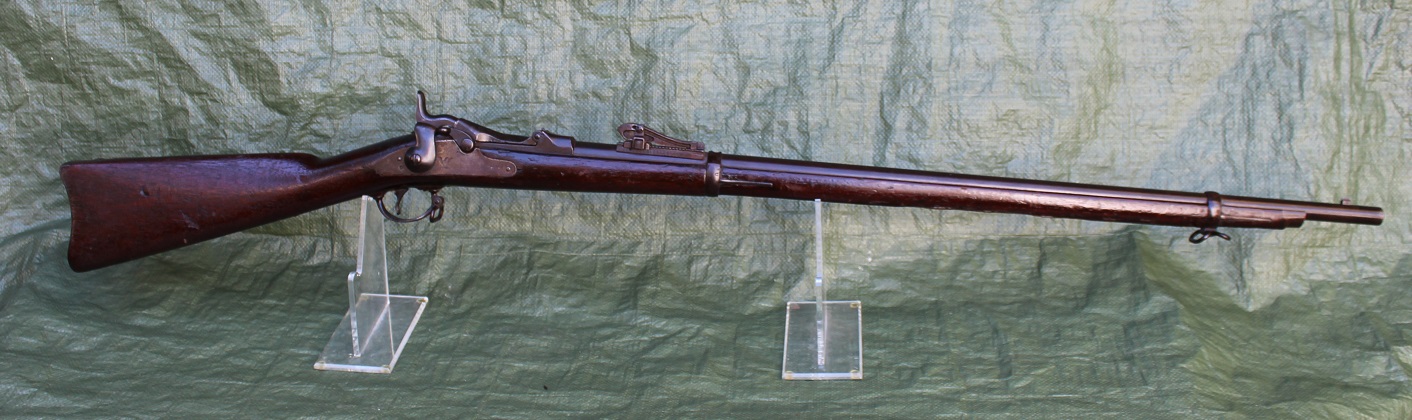
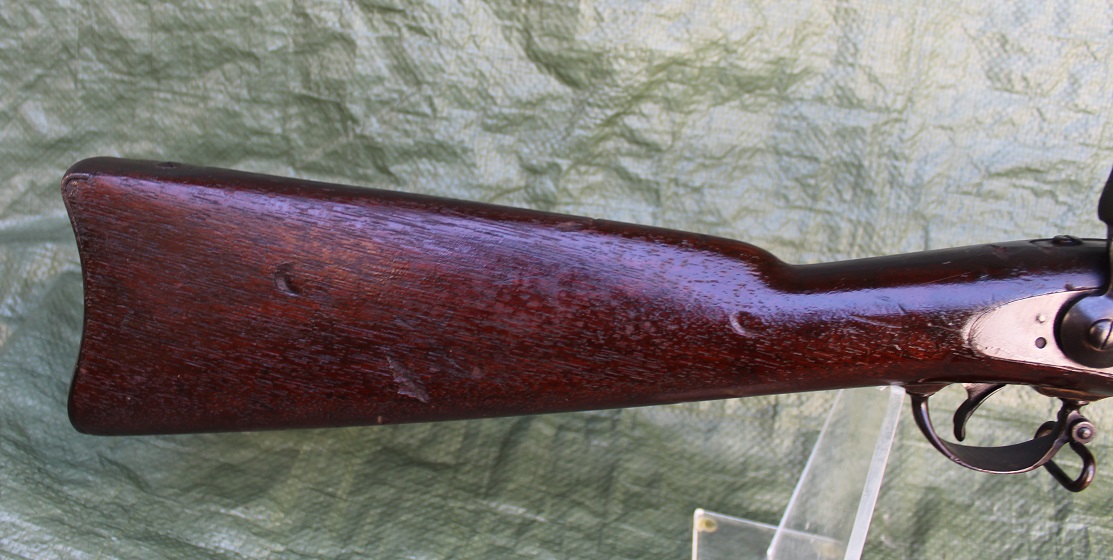
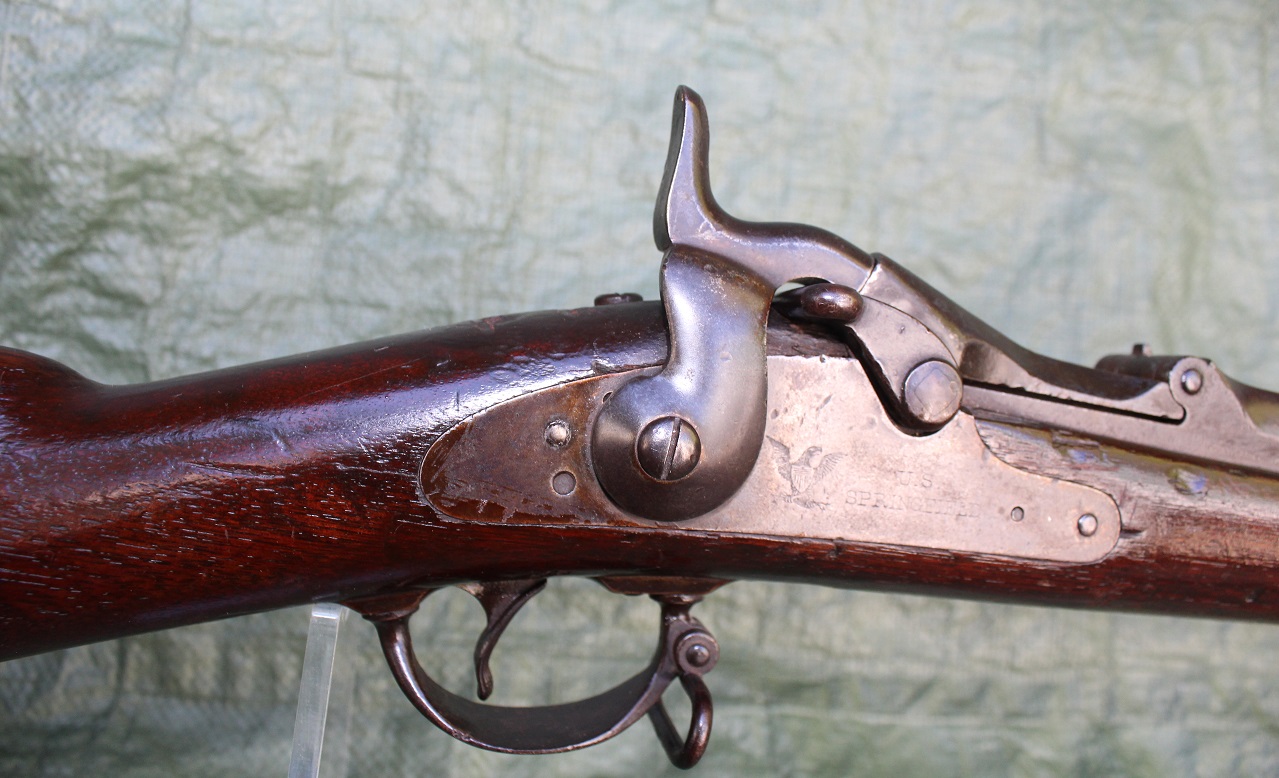
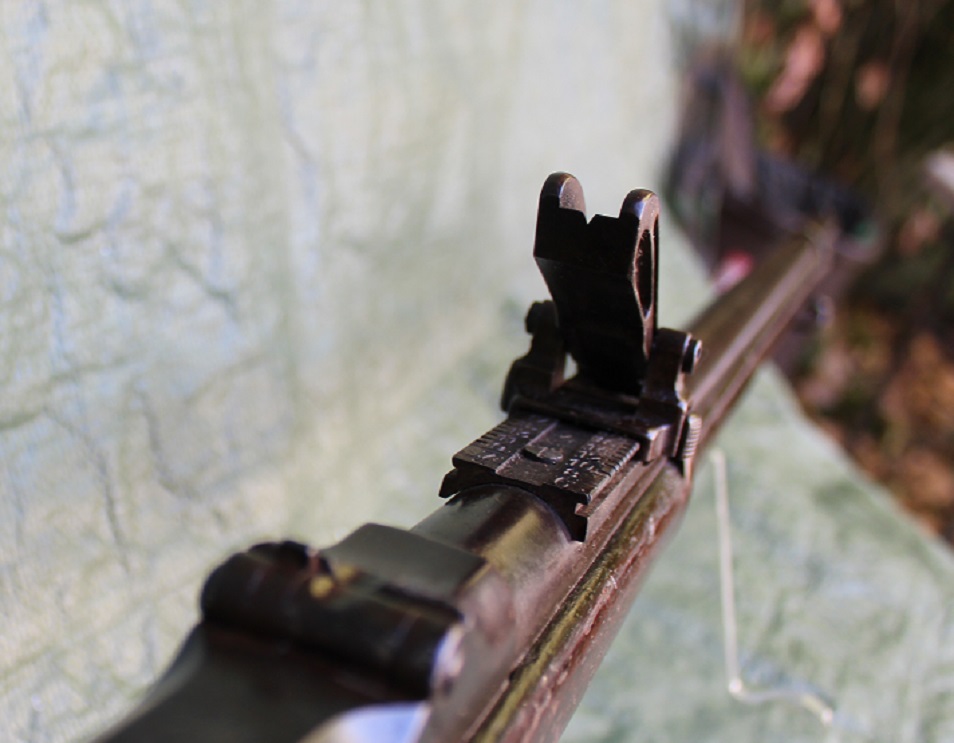
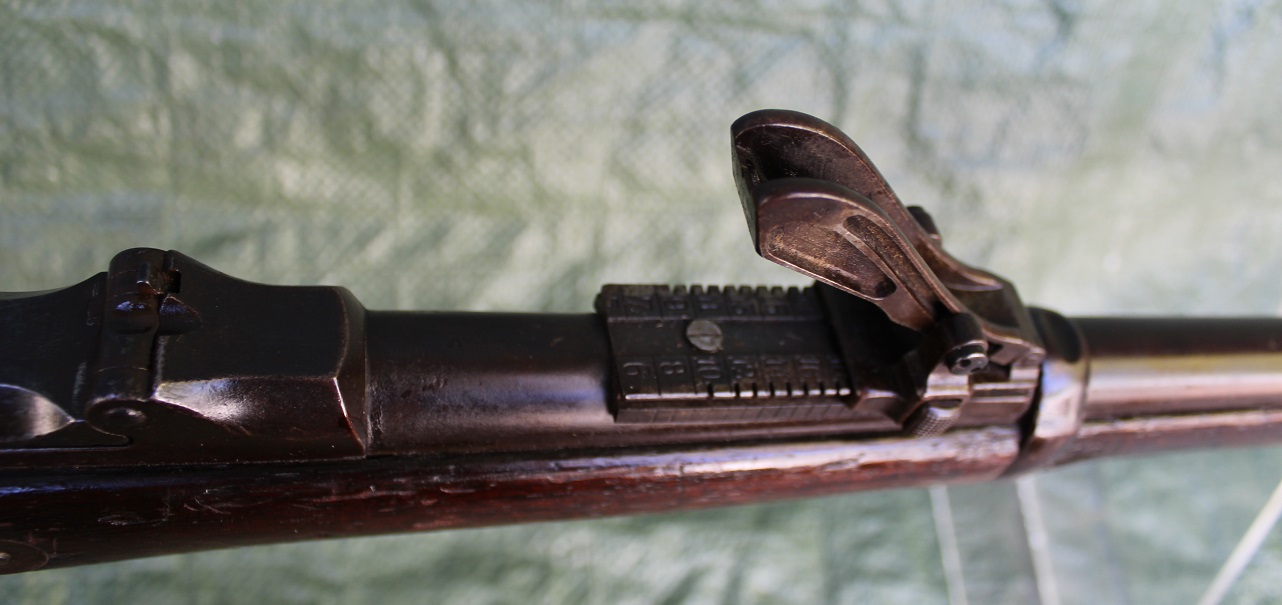
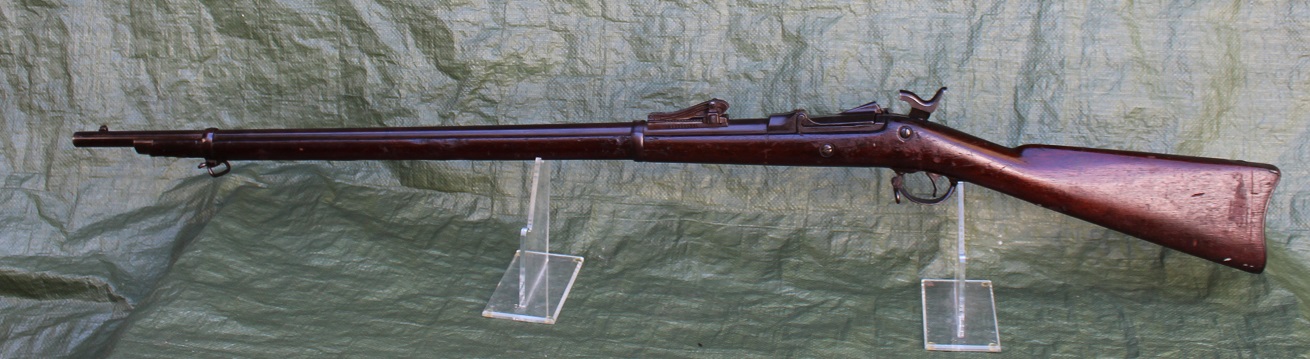
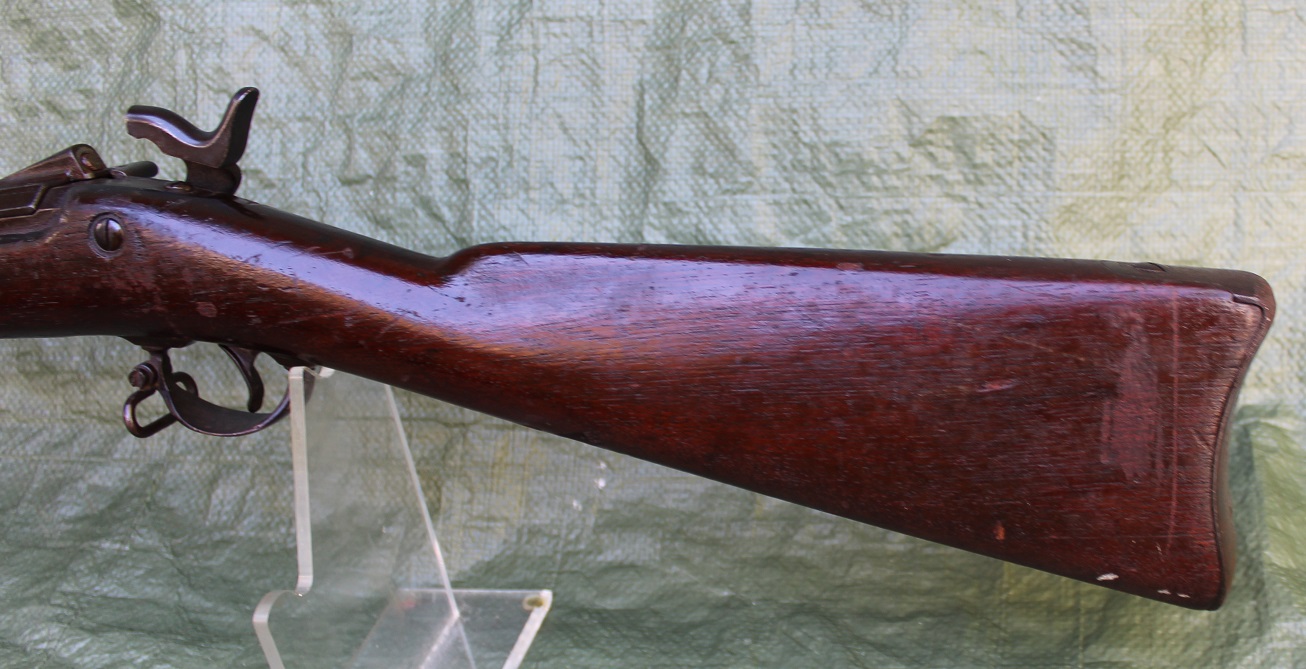
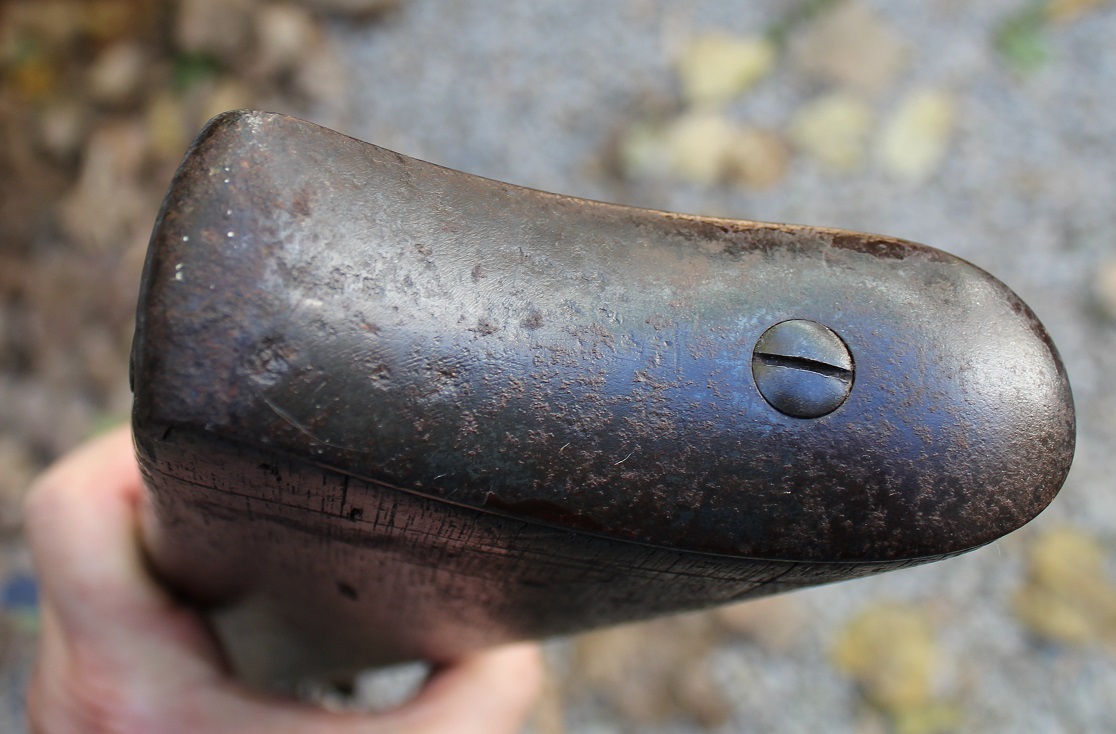
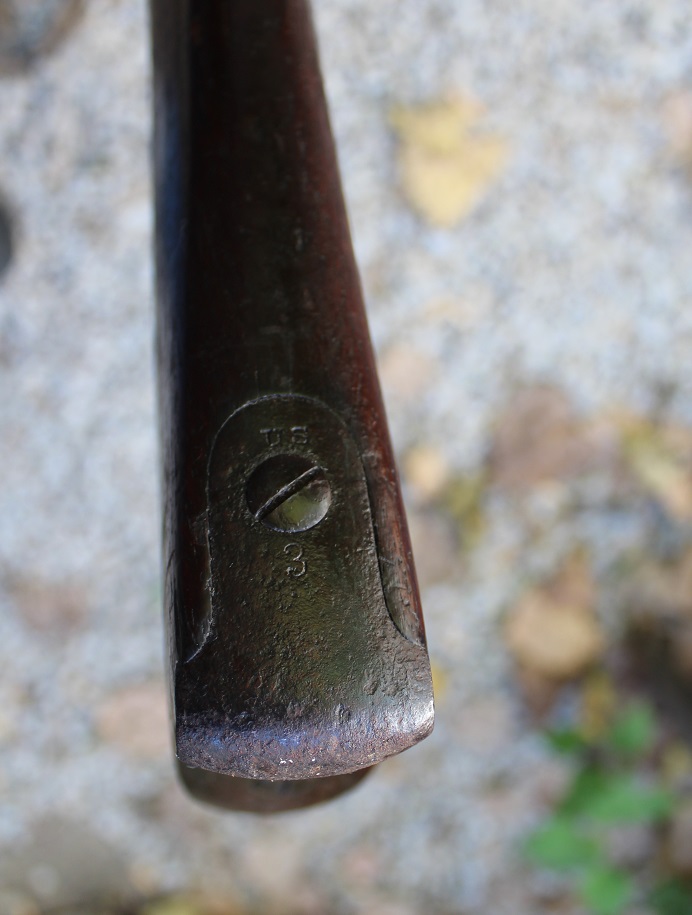
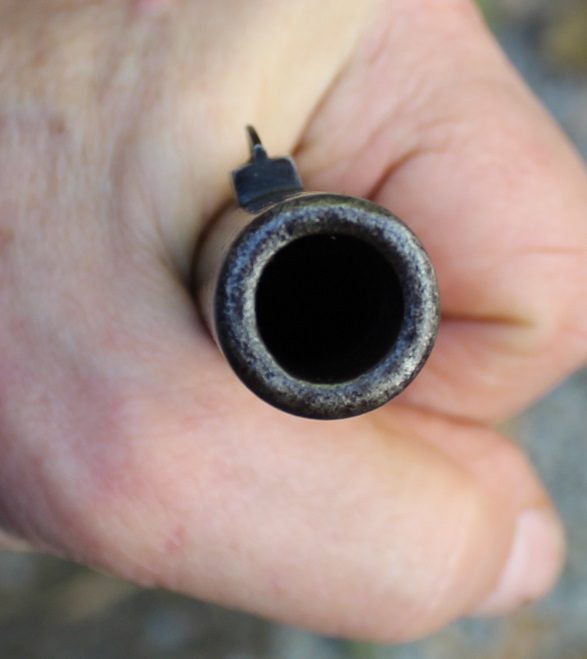
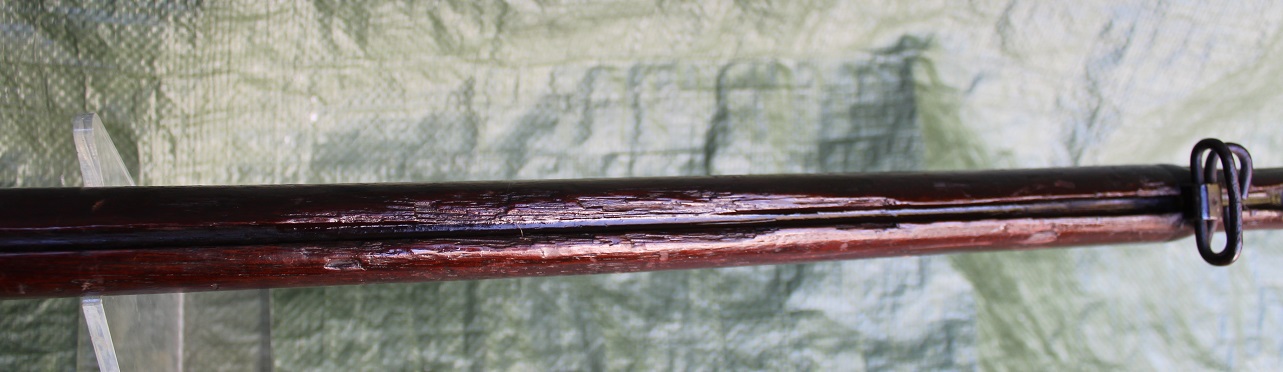
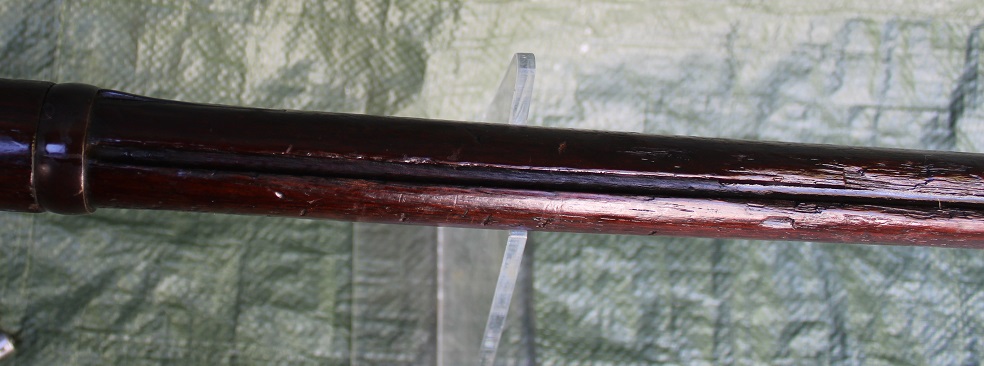
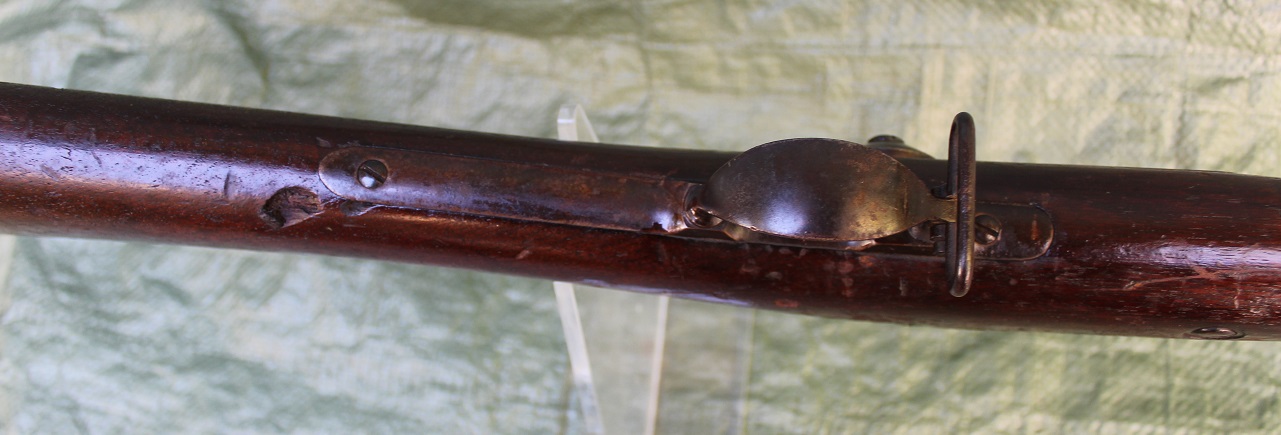
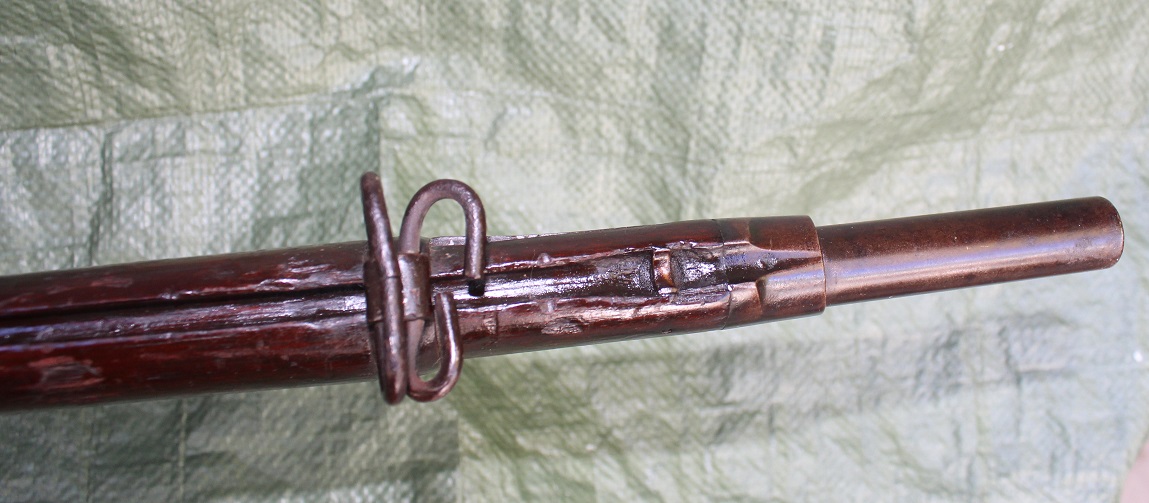
Here is a US Rifled/Musket that recently surfaced in Iowa. This 1864 dated Sprinfield musket is in exactly the conditon it was found in. Stored in an old wood shed for years this gun was well used but in nice conditon considering its age. The "US Springfield", "1864" and "Eagle" stamps are clearly visible. The rear sight is missing and the screw in the hammer is a period replacement. Ram rod appears original to the rifle but is not the original ramrod. The gun functions but needs work on the lock. The barrel does have rifling in it but the bore is dark. This gun came straight out of a family. The gun has just been in a closet for the past 10 years. The wood is in good condition with no breaks and just minor cracks and a small gouge here and there. The wood appears to have been shellacked in the distant past. The gun is complete with swivels however the one at the trigger bow is frozen. The nipple is present but somewhat flattened. The piece was stored upright in that old shed so the buttplate has some corrosion but the US is still barely seen. This rifle exhibits the same patina over all of the metal surfaces. A close examination of the barrel shows that the proof marks and date were removed for some reason but it's the correct barrel guaranteed! It's believed that this old piece was a captured piece that was reworked to get it back into working condition. It shows signs of having been taken apart to be worked on. Who knows what the history is! Could be something very special! Still a nice piece and worthy of restoration! $895.00
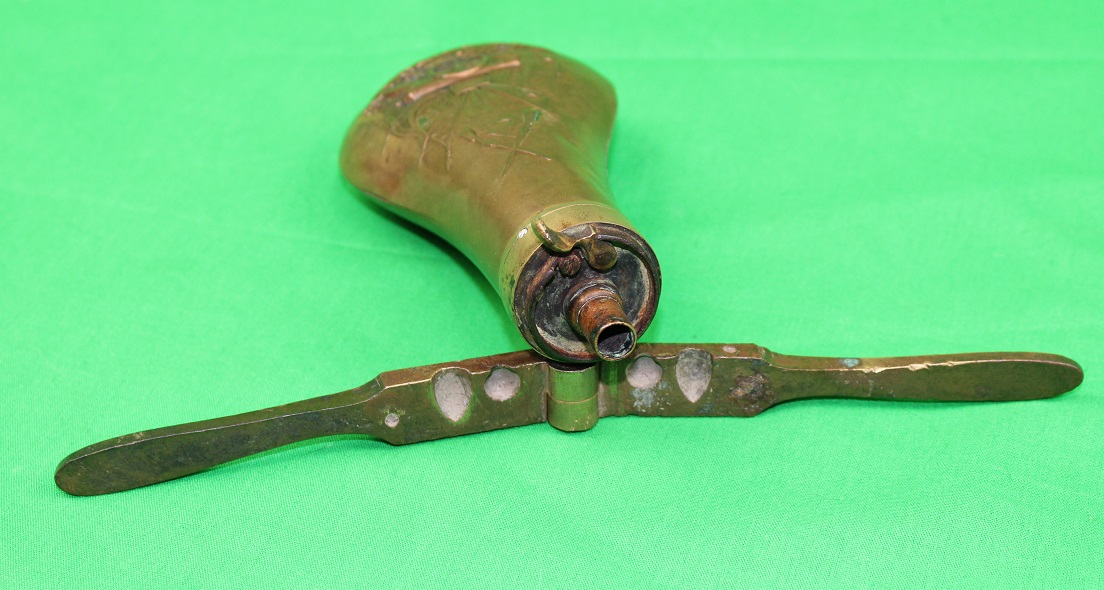
1837 AMES PEACE FLASK - FIRST YEAR OF PRODUCTION - Can't get any earlier on these and this one has been through a lot based on the amount of wear, repairs and missing parts! Inspectors stamp 'WS' is on 1 side next to eagle's head and 'N.P. Ames' "1837' on the top. Has 1 original suspension retangular ring and one later round model replacement that is loose. The charging mechanism is missing under the top lid and so is the spout. The bottom seam has been lead or solder fixed. There is one 'healthy' push to one side but the other is fine. Hey, it's been through alot but this one is $150 instead of $600 to $800. It'll still display well and it's all original! The flask has a nice mellow patina! $150.00
--------------------------------------------------------------------------------
This is the generic Remington-Lee Bayonet Model 1882. These bayonets came in two lengths and this one is the short length of 18 inches. This piece is close to the 1873 bayonet in looks but is too small to fit over the barrel of a trapdoor. Remington short generic export bayonets were used by China, Cuba, and Spain. this piece has a 2 5/8 inch socket and a wide motise. See no 28 ion page 46 of THE AMERICAN BAYONET 1776-1964 by Albert N. Hardin for the long version. During the 1880's, the US exported many Remington rifles and bayonets worldwide. The Spanish later turned these rifles against the U.S. The Remington Lee rifle was purchased by a number of nations. It was supplied with a socket bayonet that had a choice of two blade lengths. There was a 21 inch blade and an 18 inch blade like this one is. Excellent condition with absolutely no markings. If you have one of these rifles you need this nice bayonet! $125.00
Here is an old BELGIAN copy of a COLT 1849 style revolver and is considered a 'COLT BREVETE'. The Belguim Companies copied the Colt with or without Col. Colt's permission, often marking them with the Colt name. I have not found the Colt name on this piece but it's plainly an infringement on the Colt patent! Among the various markings there is an ELG in a circle on the cylinder. I believe there is some cylinder scene left as well. This one is a 5 shot model with a long cylinder and is marked 35 CAL. The "Crown N" proof was the Belgian proof used after 1852. The revolver is all complete and operating with matching numbers. The main spring is tight but functions well. The action seems to be fairly tight. The pistol is all iron manufacture. There is an area of case hardening colors on the frame, but there is basically no finish remaining and scattered roughness overall. There are manufacturer information on the top of the barrel but the makers name is not dechiperable. I believe the piece to have been cleaned. The one piece walnut grip is nice with no chips or cracks. The original nipples all are in nice shape. I've been told that this pistol was a cheaper alternative to the Colt pistol and you do find many scattered throughout the country. These pistols probably came through blockade runners or through Mexico. This is one interesting piece and much cheaper than a comparable Colt! $425.00
I just picked up a few items from a friend of mine and here they are. The first item is a model 1853 Enfield Type III rifle musket. This one is in very good condition with a nice bore. The barrel is marked with Birmingham Maker's marks as well as the date 1861. There are no guage or caliber markings. The lock is marked with a Crown and 1861 TOWER. There are also letters L.A.C. on the lock and barrel which stands for London Armory. The London Armory weapons were in wide demand so some dealers in these weapons stamped their weapons with L.A.C. thinking that it would fool buyers into thinking they were getting London Armory weapons. We believe that this is what was done with this weapon. The Confederates were quite fond of L.A.C. made rifle muskets as the parts were interchangeable, more than the other makers of the Enfield rifle/musket. The Enfield was the most widely imported arm into this country during the Civil War by both sides. These weapons were quite dependable and well favored. This one is an early one and we believe it was imported by the confederacy as noted by it's original brown pigskin rifle sling which has been repaired a few times and the letters C.S.A. stamped into the stock. There was really no reason to stamp C.S.A. into the stock but some soldier may have done it himself. The letters are all individually stamped and well worn with time. There are no other import marks nor are there any other english proof marks on this rifle except for the Birmingham Makers marks on the barrel. The action works fine. The nipple is a replacement and the ramrod is missing. The walnut stock is in very good condition with no breaks just a few dings from use and a couple of minor stress cracks, one at the tail of the lock and one behind the tang of the barrel. There is some evidence of burning on the stock near the nipple and pitting on the top of the barrel from many shots being fired. All of the metal parts exhibit a nice patina and are matching. There is also some minor tiny paint spots on the stock from leaving the rifle displayed on the wall or over the mantle when they painted the room. This is very minor and really does not detract from the piece. $1650.00.
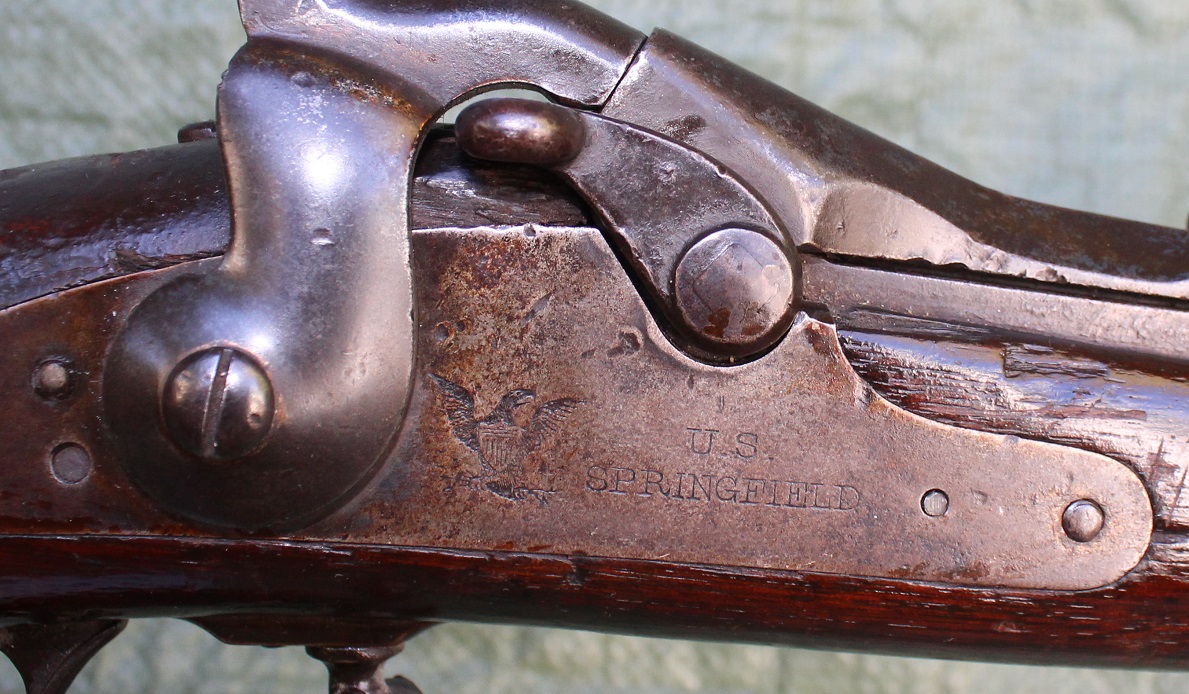
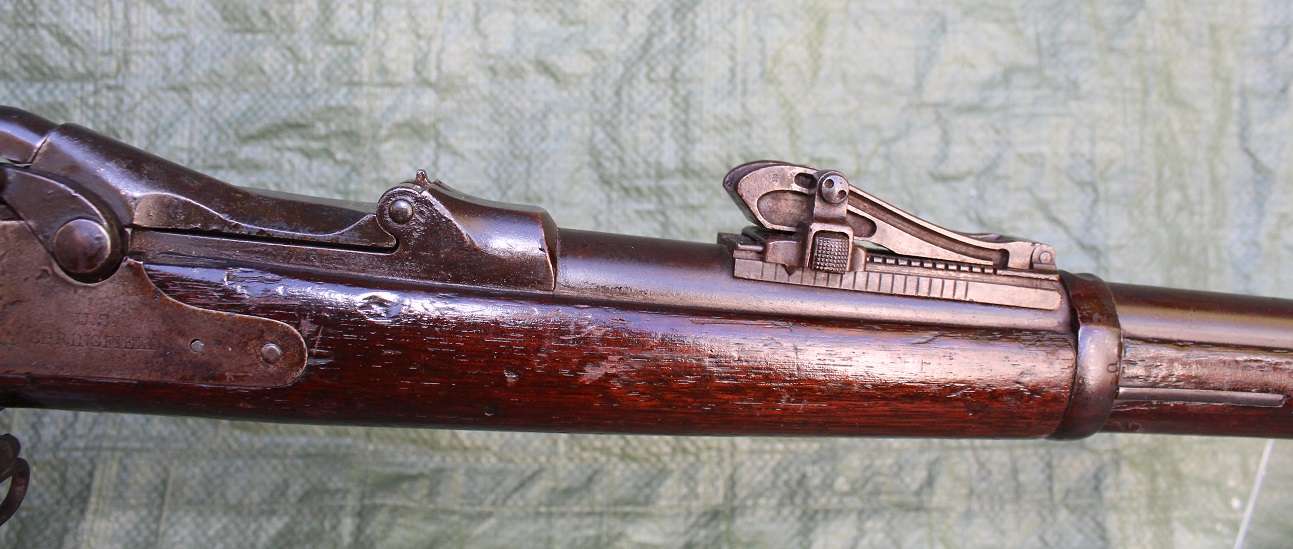
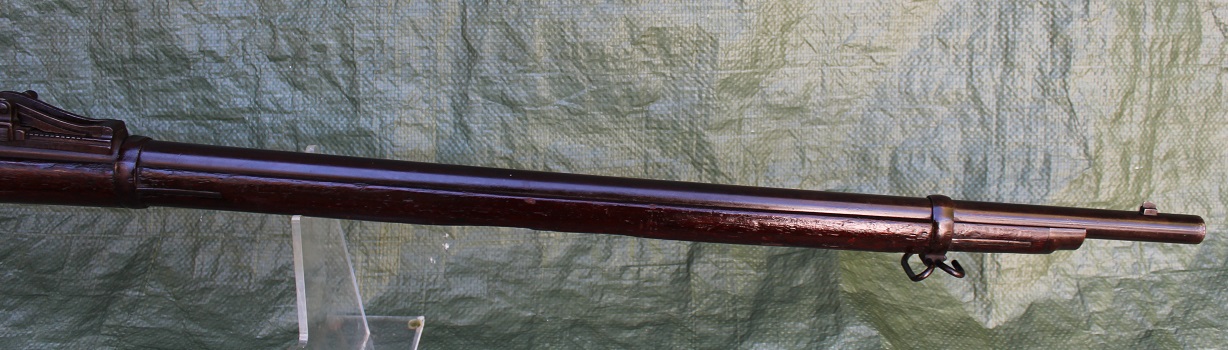
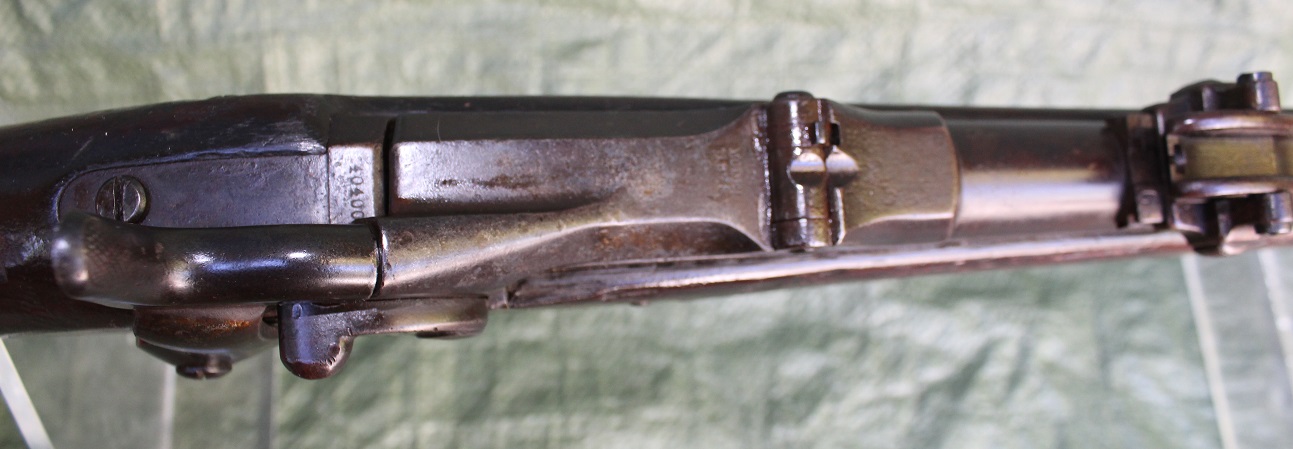
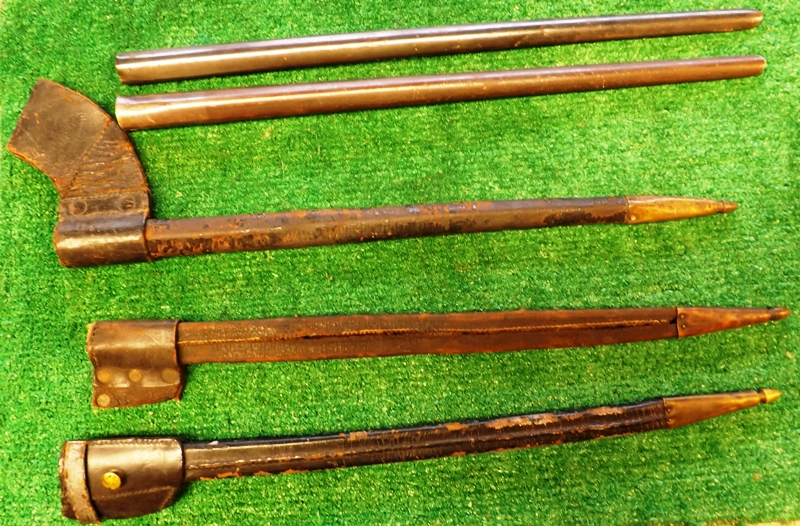
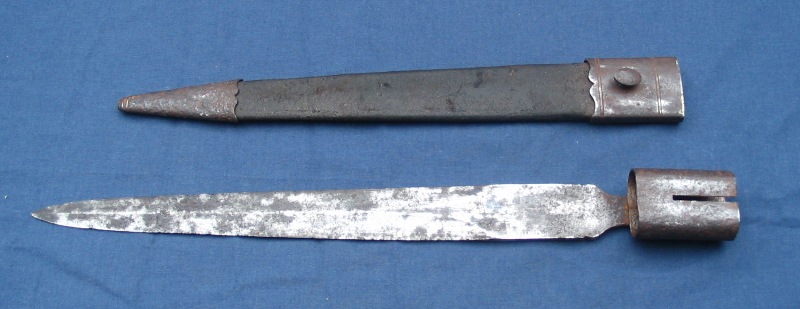
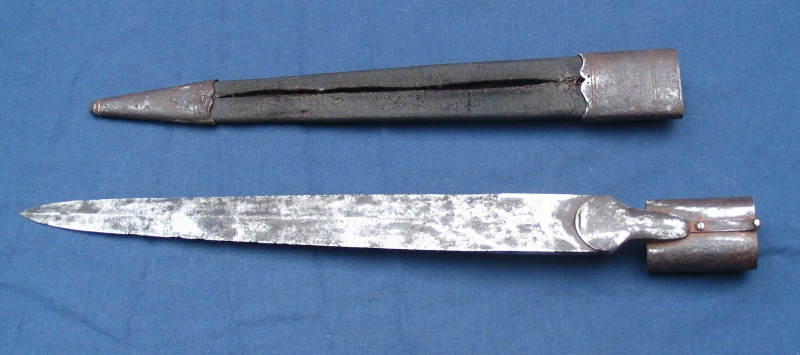
This next item came with the Trapdoor Springfield above but doesn't quite match it in patina. This is a socket bayonet manufactured from the period of 1873 and used to about 1900; it is very similar to its predecessor: the US Model 1855. They also saw service in state militias and guard units until about the end of WWI. They are typically American in design in that they do not have a blade "shoulder" and have deep fullers (or flutes), whereas British bayonets of the period had a shoulder and had shallow fullers that stopped at the shoulder of the blade.
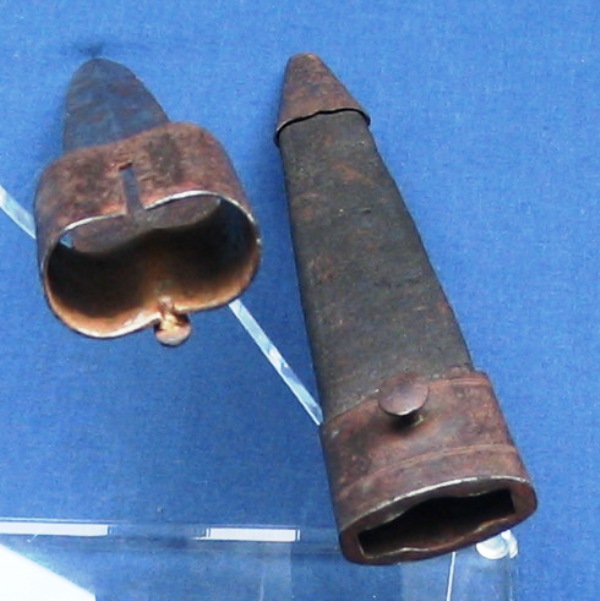
These are attached by fitting them over the barrel muzzle, and fastened into position by means of a mortise slot and locking ring.
All metal construction.
These were designed to fit the 45/70-caliber 1873 "Trapdoor" Springfield Rifle and its variants. This bayonet is in the Scabbard Type No.l III with the brass belt hook.
* Blade length is about 18";
* Muzzle ring diameter is ~0.73" (internal);
* Socket length is 3".
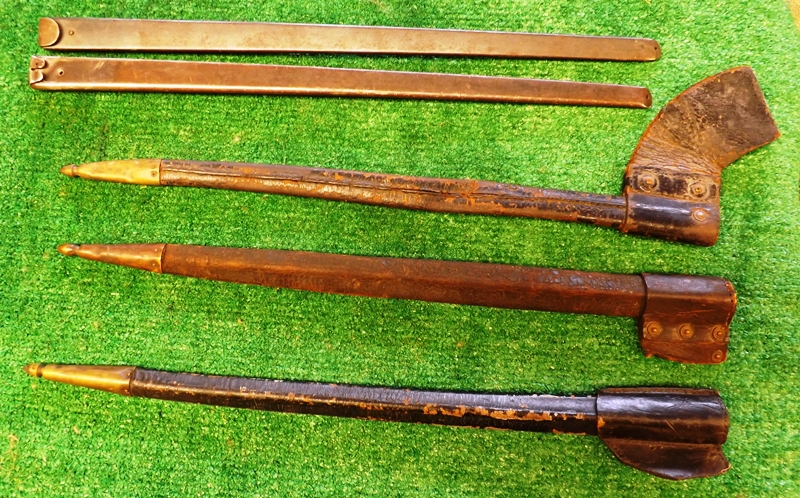
Scabbards were rolled sheet-steel with leather frog/belt loop; circular brass "rosette" is attached to swivel on frog. This one is in very good condition with some wear to the bluing on the blade and socket and a little minor pitting to the top of the blade. The scabbard body is in about 96% condition with the bluing. There is no dents to the scabbard and the leather/US rossette is in excellent condition. This is a nice piece with most of the bluing remaining! $195.00
Here's a longarm that I thought was worthy of restoration. This is a model 1853 Enfield Rifle Musket Type III that when I got it from Vermont was in terrible condition. There are a couple of reasons that I thought this piece worthy of restoration because of it's possible CS association. We believe it to be a vet bringback to Vermont. The lockplate has the crown but absolutely no evidence of a date or any other markings. Also the rear sight is missing (they were soldered on) and a simple groove cut into the barrel for sighting. The sling swivels are missing as well. I have seen CS weapons with such modifications that you usually don't see with Union used weapons. The barrel is marked with a '25' for .577 caliber weapons but the '5' is well worn and only seen under magnification. Only export weapons were marked with the '25' guage mark. The Union imported over 500,000 of these enfields while the Confederacy imported 300,000 to 400,000 of these weapons. The action works great and there is some rifling left in the barrel. There is no ramrod. All of the iron parts have a great dark brown patina and the brass has not been cleaned. I have left this weapon as close to original as possible and have not made the repairs invisible as they give the weapon 'character'. The stock is repaired well however and very solid. There were no cartouches present before restoration. I can't proove it's Confederate so the price reflects that at $825.00
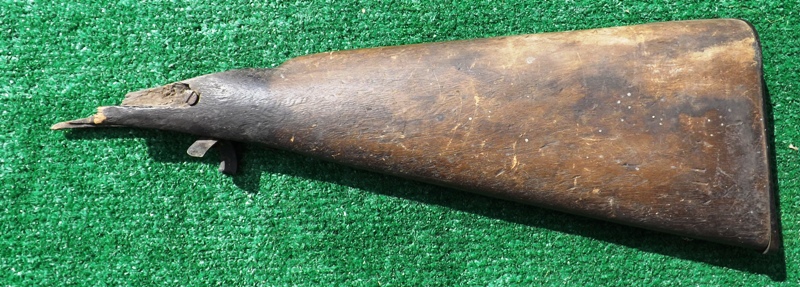
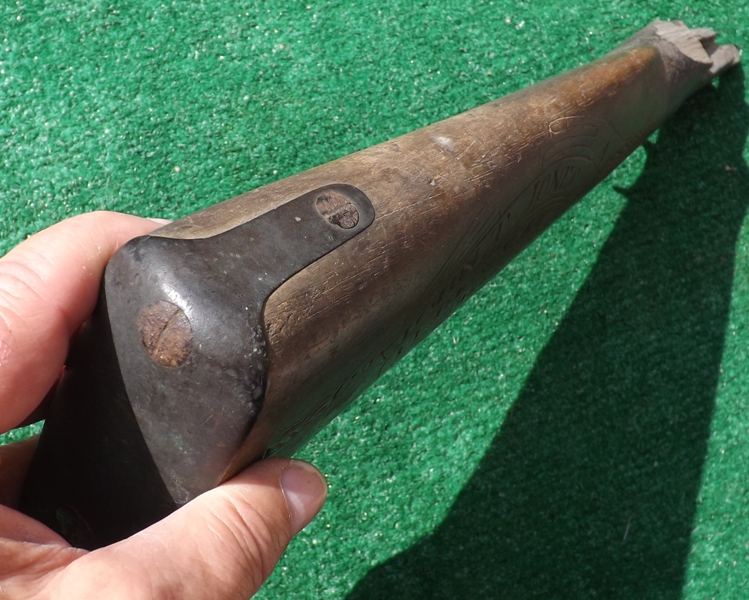
Here's a couple of old sawed off shotguns or coach guns if you prefer from the Tulsa, Oklahoma area. This first one is an A. Richards double barrel couch gun from the late 1800's in 12 guage with 18 3/4 inch barrels. This one has seen lots of use either on a stage coach, protecting a mail car or under some bar in a saloon! Heck, it could have even been used to protect prisoners or deputies at the jail. One hammer catches back but won't lock. It worked fine off the gun so a little tinkering should do the trick. The other hammer locks back fine but is missing the lock screw however it still functions fine. Good Wood with no cracks. This old shotgun also has a broken buttplate and I believe this gun has been that way for a long time. Who knows! Maybe someone knocked out someone's teeth with this gun! The barrels lock up a little loose as well. We are selling this old gun as a display piece only. This old shotgun represents great old west history! $325.00
I got this double barreled coach gun also from the same source in Tulsa, Oklahoma and is also a great cowboy gun! This one is an old double barreled 12 guage marked G C Bonehill, Maker Birmingham. I suspect Birmingham, England but it's not marked with a country of origin. This one has 18+ inch barrels and has some roughness to one barrel that I've taken a pic of for you to look at. I wouldn't shoot this gun anymore than the one I listed above except perhaps with blanks. We're selling this one also as a display piece. This one functions fine and has a lot of engraving on it. This shotgun also locks up tighter than the one listed above but you would still need it to be checked out by a competent gunsmith even before shooting blanks in it. The forearm is held on by velcro but you can't really tell. The wood is in good shape with no cracks however a small sliver is missing on the toe of the buttstock. This old gun may have thumped some criminal in the head and got damaged! There is a Silver Shield escrutchion present as well on the buttstock. $350.00
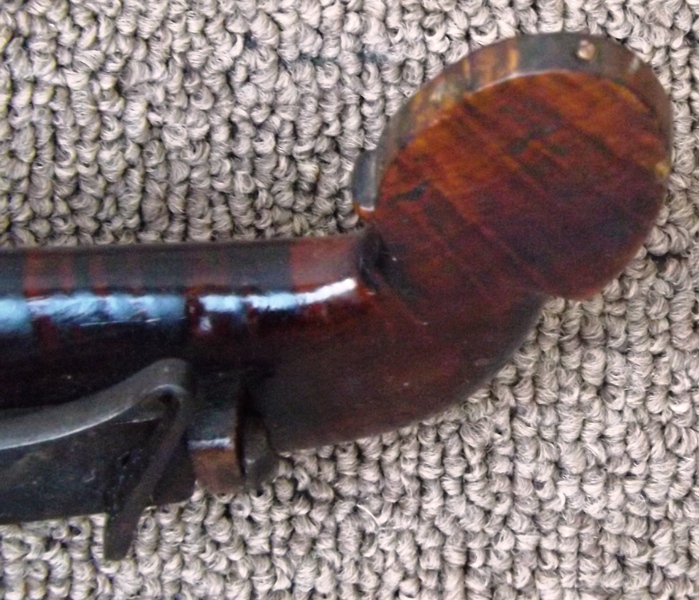
p> Here we have a Belguim made ELG marked Percussion Single Shot Boot Pistol 45 Caliber. This is a nice little gun that measures about 8 inches long being in great condition with a little shell shaped lid on the bottom of the grip to store percussion caps in. This is a nice little boot or vest gun carried by soldiers and gamblers alike! Never know when you might have to defend yourself! $245.00

Here we have an old Bannerman's type Display from the late 19th / early 20th century. Bannerman put out a catalog and anyone in the collecting field has heard of Francis Bannerman. This display of crossed axes is typical of the kind of thing he did with surplus from the time period. Each of these axes are somewhat different in design but still remarkably similar. Each ax measurea about 19 inches long from tip of blade to end of handle. Each blade has different designs on it and each hardwood handle has different designs as well. You can see that the handles were cut so that they would fit together in this 'X' display. The old bolt has a square nut on the reverse as shown in a pic. If anyone knows the origin of this type of ax just let me know and I'll post it. These are actual weapons and not just designer blades. I believe them to have age to them. $185.00.
We just picked up this outstanding group of items belonging to Captain Matthew H. Peters who was in the 16th Ohio Infantry and the 74th Ohio Infantry. These pieces came straight from his family and have never been on the market before. We have his .58 calibre Civil War Musket that aside from some handling marks gathered during the last 145 years it's just darn near mint! This piece has the original case hardening on the lock as witnessed in the photo and the rifling is excellent. This piece was fired but not much. This piece is a Special Model 1861 Contract Rifle-Musket made by and marked L.G. & Y/WINDSON-VT. There is also an Eagle on the lock. The piece is complete and functions effortlessly. The second piece we have for him is the 36 Caliber Savage Revolver that he carried on his person. This piece shows lots of wear with clear markings. One nipple is missing. No cartouch on the grips but they are worn so the cartouch may have been worn off. The 3rd piece is an old percussion rifle that he may have sent back during his journey through the south. This piece may be contraband and shows how nothing went to waste! We're doing the research now and will keep this updated as we get it. Here's Captain Peter's Bio. :
Matthew Henry Peters Residence Springfield OH; a 19 year-old Brick Maker. Enlisted on 4/23/1861 at Springfield, OH as a Private. On 4/26/1861 he mustered into "E" Co. OH 16th Infantry He was Mustered Out on 8/18/1861 at Columbus, OH On 1/7/1862 he was commissioned into "F" Co. OH 74th Infantry He was Mustered Out on 7/10/1865 at Louisville, KY He was listed as: * Wounded 12/31/1862 Stones River, TN (Severely wounded) * Wounded 5/9/1864 Buzzard's Roost, GA (Wounded in right leg) * Wounded 12/21/1864 Murfreesboro, TN (Wounded in wrist) Promotions: * 1st Lieut 1/7/1862 (As of Co. F 74th OH Inf) * Adjutant 3/1/1864 * Capt 7/13/1864 (As of Co. H) * Major 7/12/1865 (Not Mustered) Intra Regimental Company Transfers: * 3/1/1864 from company F to Field & Staff * 7/13/1864 from Field & Staff to company H Other Information: born 6/6/1841 in Bavaria, Germany died 5/11/1918 in Watseka, IL (Son of George & Magdalena Peters. Married Clara Lyon on 06/19/1867) After the War he lived in Watseka, IL
We did get from the family that Matthew did settle in Watseka, Il after the war and eventually became Mayor of that town in 1875 and in 1878 Matthew was elected as an Illinois Representative. We are going to Watseka on a research trip. Capt Peters was born in Germany and he was brought to this country by his family in the year of his birth 1843. Capt Peters was born on June 6th, 1843. His family settled in New Orleans where his Mother and his 2 sisters died probably from fever since the climate was different that what they were used to. That left his father to raise the 2 boys but the father contracted Yellow Fever as well and he too died leaving the boys orphans. Matthew was taken in for a fellow but he was cruel to Matthew so during 1855-56 Matthew ran away. His younger brother was left in an orphan asylum. After some time of fending for himself he gained employment on a Mississippi River Steamboat where he befriended a traveling gentleman, Henry S. Roberts who took him home to Ohio. Matthew was left with Mr. Roberts widowed mother who took care of Matthew so well that Matthew kept her with him to live after moving to Watseka, Il. The family I procured these items from gave me a copy of a Portrait and Biographical record that was written in 1893. Capt. Peters organized the first Militia Unit for Iroquois County where Watseka is located and was elected Colonel of the outfit. He was also Post Commander to the local GAR post and was a member of the Illinois Loyal Legion. Matthew also was the owner and publisher of the Watseka Newspaper. Quite a career! UNDER RESEARCH! CHECK OUT THE PICS! OUTSTANDING!! For all three pieces $6500.00
Here is a nice winter project being an original Civil War era Tranter Double-Action Revolver in 44 caliber preferred by Confederate Officers this is mostly complete. The pistol needs a proper cylinder pin and loading lever . the top is marked Thos Blissett South> I believe this was Thomas Blissett South Castle St Liverpool England who was a dealer and not a manufacturer. The pistol has a serial number on the right side of the frame ..the rosewood grips are in very nice shape , This is the scarcer double trigger model and with careful cleaning a few minor parts it could be a nice working revolver. The cylinder turns when trigger pulled so I believe most of the internals are present. A like example is shown on page 65 of FIREARMS FROM EUROPE SECOND EDITION by Whisker, Hartzler and Yantz. That example is id'd to A.J. Bethune of Co. E, 45th Alabama Infantry proving that the Confederates did use them. That one is serial numbered 4987 and ours, I believe is 6513. These revolvers were not usually associated with Northern Officers and soldiers. A number of this type are know with southern retailers markings including T.W. Radcliffe, Columbia, S.C., as well as Hyde & Goodrich and A.B.Griswold & Co., both of New Orleans. It is fairly certain a number of these weapons were shipped through the Northern Blockade as evidenced by the following March 10, 1863 Richmond Times Dispatch advertisement:
FINE ENGLISH REVOLVERS
Just received from England six Tranter's fine revolving pistols, 80 & 120 bore.
Price $220.00 each. H. E. Nichols, Columbia, S.C.
The price on this relic is $650.00
Here is a real nice 69 caliber rifle-musket bayonet that was issued with the converted M1835 musket and the reissued 1842 musket in the early 1860's for the Civil War usage. This piece exhibits some rust staining but not bad at all. A very nice example! The U.S. is cut very deep adn the bayonet ring moves as it should. No Scabbard. Nice!! $150.00
Next we have 2 1840 NCO swords that came from a family sale. The families name is Honan and it is believed that their Civil War ancestor was also a Honan. A search of the Honan name on the Research Database showed only 20 Honans in the Civil War with only one of them being a Sgt. His name was Martin Honan from Vermont. This family was from Northern Indiana and there was only 3 Honans from Indiana. At any rate here's what the swords are. 1st we have an Ames NCO sword w/o scabbard. The AMES is light but you can see parts of it with the naked eye and most of it with a magnifier. Also on the other ricasso is US JH (John Hannis-inspector) and the year 1862. The blade is mottled with some stable pitting being 32 inches long as it should be. A.D.K. (A.D.King Inspector) is stamped on the knucklebow. The blade has minor nicks on it but no signs of sharpening. Good overall example! $275.00
The other NCO sword is in better condition and comes with it's original all metal scabbard. This one is marked on the ricasso with an FH in an oval. The FH stands for F. Horster of Solingen, Germany. Many European countries imported swords to the States during Civil War. This sword is the same dimensions as the Ames Nco Sword. The blade on this one is a little better than the Ames. The scabbard on this sword has mottling and some stable pitting coming very close to matching the blade on the Ames indicating that they had been together for a long time up in the attic or down in the basement. This is still a nice piece and with a scabbard you don't often see. Check out the pics! $375.00
Here is an Ames 1840 NCO sword lacking scabbard. This is an 1863 dated sword. The AMES info and other other stampings on the blade are fairly nice with wear but my camera won't pick up anything that small. The blade is the correct 32 inch length and does have some rust staining and minor nicks to the edge of the blade-nothing serious however. It looks like the hilt has been cleaned. ADK inspector initials are on the knucklebow. This is a very nice overall piece. The tip of the blade has black paint on it for some reason but you can clean it off if you like. $295.00
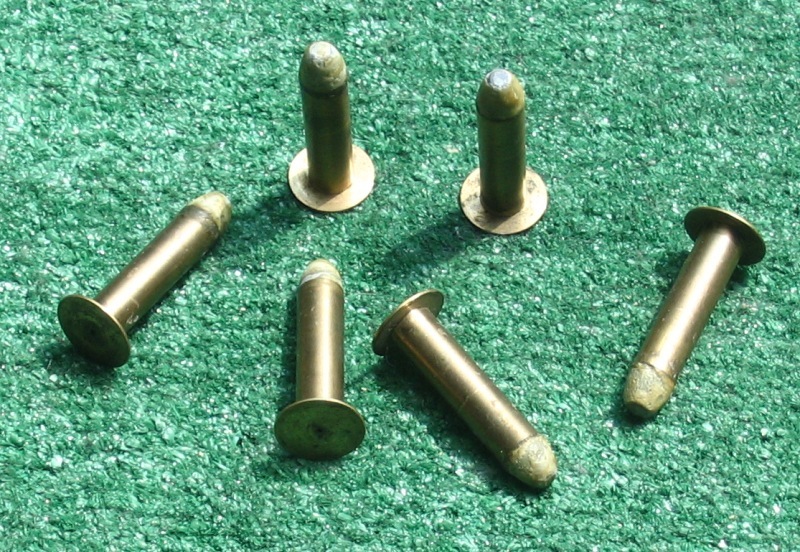
Here are 13 pinfire cartridges headstamped G anchor E . I believe them to be around 8mm or 32 caliber. Nice aged condition! Check out the pics. $15 each.

I just received this next item and it sure is neat! This is a Service record of a WW2 Naval Reserve Sailor done in the form of a serving tray. I have one for my Father as well who also was in WW2 Pacific Theatre. This particular one measures about 15 X 21 inches and has hardware on the back where it was hung on the wall. As you can see there are little round handles on each end to use it as a service tray but of course no one would use this piece for that purpose. This piece is under glass and shows a LST #817 unloading a tank on a distant beach somewhere in the pacific due to the Palm trees shown. Pasted under the image is the service record of "Billy" G. Warner S 1/c (seaman 1st class) USNR (United States Naval Reserve). Also under Billy's name is "With Honor I Served in World War II". You can see 6 service ribbons on this piece and I believe he participated in 4 different battles. I believe there are ribbons for Philippine Liberation, WW2 Victory, European Africa Middle Eastern, & Asiatic Pacific 1941-46. I don't know them all so maybe someone can help on this piece. Also there is one stamp with a star under a plane indicating that he was involved in shooting at least one plane down in battle. There is a little water damage that you can see on the top but it doesn't affect the image or the history. There is a tremendous piece to research! Could turn up something very fascinating! $65.00
Here's a pretty nice 16 ga Pinfire Double Barrel Shotgun. This is a very nice looking and handling Civil War era pinfire shotgun. It’s light and fast handling and it has some nice engraving on the receiver, the back sidelocks and on the triggerguard. There’s no maker’s name that I can find but it has serial number 6874 on the receiver. It also has a full set of Liege, Belgium proof marks on the barrel flats. You open the action by pushing a metal lever (which makes up the forend) to the left. The wood is in very nice condition but the metal has no bluing or very little browning remaining having been cleaned at some point. The bores are pitted but you shouldn't shoot this old girl anyway. It's done it's time! This piece has sling slivels so it could be slung over your shoulder. During the Civil War all types of weapons were put into service, even pinfire shotguns, especially by the rebs. I tried a 14 gauge shell in it but it was a little too tight to get in so I believe the weapon to be 16 gauge. The action of both hammers and triggers work just fine. All in all a very desireable weapon! $525.00
Here's an old war horse! This is a French Model 1857 Rifle Musket aka 1853T. This model measures 55.75 inches long overall and the lock is marked 'Mutzig'. None of this type was known to be imported by the Confederates but thousands were imported by the Union. The stock on this rifle/musket is walnut and in very good condition. The metal parts have a 'peppering' on them from being stored up in the attic. Moderate pitting is around the breech end of the musket. .69 caliber and the action works being very tight. This piece comes from New Hampshire but sadly no history accompanies it. one of the neat things about this piece is that the first barrel band/nose cap is missing but someone wrapped it very nicely with a roll of twisted brass sword wire. This wire has much age to it and I believe it to be done during the period. A soldier just had to 'make do' with what he had. This is a very nice piece and would look great in your collection! Nothing missing but that first band/nose cap. $650.00
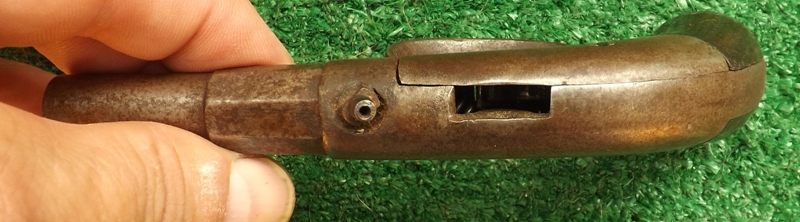
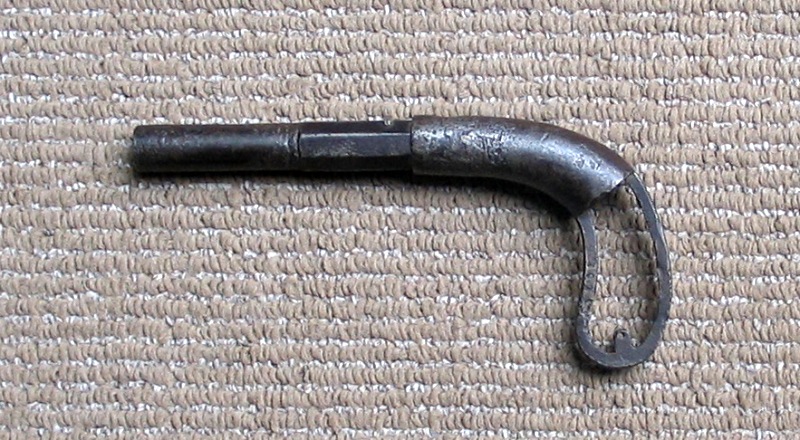
Here we have a Belguim 7MM pinfire pistol. This small pistol has a 3 1/2 inch barrel and is about 7 inches long overall. The grips are very nice and there is an 'N' carved in it. This is the folding trigger type. The piece functions as it should but it's missing the loading gate. The ejector rod is present. Nice little pistol! $295.00
Here is a homemade knife that just screams Dixie! This sideknife has a nearly 7 1/2 inch blade that looks like it could have been made from a file. It looks like soldered was applied between the cross guard and the blade to tighten it up. I believe the blade was cleaned up at some time. The cross guide is iron and looks very crude. The 4 3/4 inch grip is smooth from wear and is capped off by a beveled end cap. The entire piece is crude and measures over a foot long. This piece is outstanding! $325.00


What we have here is an old single edged dagger that was made from two different knives. The blade is definitely old with much aging on it. The handle is the cutlery type handle being silver plated and also definitely old from the 19th century. I'm not real sure on the brass crossguard. It looks as though the handle was soldered to the blade but a real nice job. It also appears that the entire piece has been cleaned up some. The knife is almost 11 1/2 inches long with a 5 1/2 inch blade. No markings on it anywhere. This piece is definitely Civil War era just made from 2 different knives. Solid as a rock! From a Michigan estate sale. $175.00
Here's a nice "Cowboy" bowie knife from, at the earliest, the 1890's. This piece has seen much use as witnessed by the smooth grips. These are stag grips so they would have been rougher, I believe. The entire piece measures over 9 1/2 inches long with a blade that measures over 5 1/2 inches long. The blade has 'NON-XLL' stamped in the middle on one side with 'Joseph Allen & Son Sheffield, England' stamped on the ricasso. The blade has been sharped some and is stil sharp. The slab grips are held on with 3 brass pins. This piece reeks of character!!! $125.00
Here we have an Indian Wars late 1800's side knife that was popular with the Soldiers, hunters and Gold Miners! It's a real nice piece with an approx 6 inch blade and very nice stag grips! The ricasso has on it 'Joseph Allen & Sons Sheffield, England'. The blade has been sharpened some but it's a great piece! The knife is about 10 inches long overall. $135.00
"CIVIL WAR TRAINING RIFLE"------------ Here's another unique item! This is an old Civil War musket that was converted after the war for use by the many Military Academys around the country. This is an original US Springfield musket dated 1864 that was shortened to a 2 band rifle and had a wooden dowel affixed between the breech and the front part of the barrel so that it could not be fired, only used for drilling. The original .58 caliber bayonet is also included with the piece as shown in the photos. Wooden-barrelled training muskets were made up by Francis Bannerman in the late 1800's and this certainly could be one of those. Francis Bannerman was a famous dealer of military surplus, who established a business headquarters and warehouse in an "armory" that he built on an island in the Hudson River. The facade was inspired by a Scottish castle, and its crumbling ruins still remain today, preserved as a park. It was consumed by fire many years ago. Some of the old timers still talk about the wonderous bargains that could be had at Bannermans! Bannerman produced a paper catalog which is still available as a reprint, and is an excellent reference for identifying old militaria (much like vintage Sears catalog reprints). Much of his inventory consisted of Civil War and Spanish-American War military surplus, including guns. In the late 1800's and early 1900's, military academies and community marching groups were a very popular social activity. There was no anti-war stigma at the time. Obsolete muzzle-loading Civil War muskets and Trapdoor Springfield rifles with condemned (unsafe) actions were made into lightweight training and marching muskets for youth by removing the original barrel and replacing it with a wooden barrel turned to the same contours. Often the last six inches or so of the original barrel was cut off and attached to the training gun, with the joint covered by the last barrel retaining band. This muzzle allowed attachment of the original bayonet for drill purposes. These non-functional but realistic guns were sometimes referred to as "Quaker muskets" with reference to the pacifist Quaker movement in the US. Various grades of these drill rifles were listed in the Bannerman catalog and now you have a chance to buy one made up of most of the original Civil War Musket! $325.00
Indian War period knife imported from England. The knife measures 9 3/4 inches overall with a 5 1/2 inch blade, stag handle with 3 rivets / pins. The knife is blade marked NON-XLL that was manufactured by Joseph Allen & Sons, Sheffield, England. The knife has a steel blade and brass crossguard showing honest wear, no scabbard. Good condition! $125.00
Here's an old hand made bowie knife that is made from one piece of bar stock with the grip wrapped in old cord. The crossguard was 'pinched' onto the blade to keep it into place. The blade and crossguard have traces of Gold Paint on them which makes me believe that this piece was on display at an old GAR hall. This piece is very unique and heavy! The entire piece measures 12 1/2 inches long with a 8 inch blade. This thing screams DIXIE! $325.00
Here's something that I don't see every day. This is a Philippean Visayan Tenegre sword from the 1800's I believe. I did some internet research and this is what I believe this sword to be. This piece is well made with a polished hardwood handle of some sort. There is some damage to the hand that you can see in the pic and there is a couple of age cracks in it. The blade is well made having a beveled edge on one side and a flat edge on the other. The blade measures 20 1/2 inches long while the entire piece including grip is over 25 inches long. The blade is 1 7/8 inches wide at it's widest point. It comes with an old leather scabbard that you can see is hand sewn. Outstanding tribal work! $375.00
Here's another item that I don't see every day. This is a near relic what I believe to be an Indoneasian Execution sword. The blade is very rusty with what appears to be a design on it of perhaps a snake. The blade is over 28 inches long and 2 1/4 inches wide at it's widest point. The aged wooden grip is about 9 3/4 inches long with age cracks. I believe something is missing on the grip as well. The grip seems to be some kind of animal or something. The blade is fairly thick. I believe this one to be from the 1800's as well. No Scabbard. Gruesome! $145.00
This item here belongs to a friend of mine. Her husband passed away and this was a point of particular pride to him. This is my eldest grandson holding a Christian Beck Rifle made in Indiana prior to or just after the Civil War. Christian Beck was born in Pennsylvania, I believe, in 1813 and died in Marion County, Indiana on August 17, 1886. Christian was the brother of Samuel Beck who also made rifles. Christian was a gunsmith in Connersville indiana and moved to Indianapolis in 1835. He was a gunmaker in Indianapolis for main years with the last year of record being 1880. Christian made both flintlock rifles and percussion rifles. Christian held 3 ranks during the Civil War. Here are his stats:
Residence Connersville IN; Enlisted on 9/25/1861 as a 1st Lieutenant. On 10/5/1861 he was commissioned into "L" Co. IN 2nd Cavalry He was discharged for promotion on 11/2/1863 On 11/2/1863 he was commissioned into Field & Staff IN 7th Cavalry He was discharged for promotion on 3/1/1864 On 4/30/1864 he was commissioned into Field & Staff IN 9th Cavalry He Resigned on 10/28/1864 Promotions: * Capt 6/21/1862 * Major 11/2/1863 (As of 7th IN Cav) * Lt Colonel 3/1/1864 (As of 9th IN Cav)
When a captain in the Civil War, his outfit was surrounded by Rebs and he and his men cut their way out without losing a man. For this deed the Governor of Indiana, Oliver P. Morton, persented him with a gold-headed cane. This rifle is one of the many very nice weapons that Christian made and his rifles are highly regarded and collected by Indiana collectors. This one is a very nice half stock rifle being about 48 1/2 inches long with a 32 inch barrel. This rifle was restored sometime in the 1960's I believe and that info is stamped on the barrel. The stamping says 'REPAIRED BY WM. H. VIETOR.REELSVILLE. INDIANA. -CAL. 343.' On the top of the barrel is stamped 'CH = BECK' 'IND'POLIS WARRANTED in 3 lines. There is some engraving on the backstrap and triggerguard. The lockplate and hammer are also engraved and the plate appears to be stamped 'LEMAN' 'ANCE' with the latter letters being worn some. There is a piece of wood replaced in front of the bolster that was probably burned by the percussion caps. Because of this I believe a 'cup' has been added around the nipple. There is also a crack in the obverse stock by the lockplate screw (also engraved) that is held inplace by a small nail or pin. The stock appears to be a nice walnut piece of wood with a brass cresent buttplate. The octagon barrel is very heavy with brass soldered pipes for the ramrod which I believe is a replacement. There is a very nice simple pewter nosecap in place. There are 2 triggers with the rear one being the set trigger and the front straight one being the 'hair' trigger. Does't take much pull for this one. Virtually no pitting to the metal. This is a nice one! I've taken a lot of pics so check them out. $1,250.00
This here is an 1860 Cavalry scabbard but it's about 3 inches too short for my Ames 1864 Dated Saber. This piece would fit a saber that's about 31 1/2 or 32 inches long. The Ames saber slips in effortlessly but like I said the scabbard is about 3 inches too short. The piece is in excellent condition with the bottom half being nickle plated for some reason. This is the old nickle plate and not the new electroplated stuff. The throat is exactly like the 1860 cav saber scabbard. The rings are present and in good condition. There are no markings on this piece. Not guaranteed to fit your sword. $175.00
Here is a very nice Belgian London Marked Percussion 12ga Double Barrel Shotgun. The barrels are marked LONDON on the rib, but have a Liege proof mark under the stock. They are 32 3/4" in length. The gun is 48 3/4" overall. There are no makers marks elsewhere. The locks do work, but are a little loose and have 3 click tumblers. There are a couple of minor cracks in the wood, which is walnut I believe, but nothing bad. The barrel has some light pitting. This is a very attractive piece that you're sure to like! Nice Civil War era piece! $375.00
This is a nice primitive French & Indian or Revolutionary War Era Pike head that was found in Lafayette, Indiana. Lafayette, Indiana is the site of an early French trading post known as the Fort Ouiatenon Blockhouse (1717-1791). Look at the pics and you can see what a primitive Blacksmith item this is. $275.00
Here is another nice knife that is from the Revolutionary War period. this knife measures over 12 inches long with an approximately 8 inch blade. There are no markings on the blade as all and it has been sharpened at some point in it's life. It appears that this spear point diamond blade may have been made from a file as there are some line markings on the blade and the ricasso is reminisent of a file. The knife also has a pretty nice carved horn handle that has some damage the the pommel end that you can see in one of the pics. There is also a small brass domeand it apprears that the tang passes through it. The cross guard is a little brass piece with a brass thimble over the end of the grip that is closest to the guard. This piece also comes in it's original leather scabbard which is very supple and hand stitched. This one is also very nice from the same Indiana Estate! No History on this one either. $450.00
Very nice brass mounted 3 band Prussian Model 1809 "Potsdam" musket. Lock works excellent, marked Neisse, dated 1831 holds at half and full cock. 41 1/2 inch Barrel marked FW with crown and 1831, nipple needs replaced as it's broken clear off at the top-probably an easy out would do it. Bore is very good with old style straight lands and grooves no twist "rifling". This hugh 71-72 Caliber bore should be an interesting round ball thrower. Nice inspection "FW" marks and crowns on metal parts and wood. One small stress open grain crack for about 1 1/2 inches long at the rear point of the lock plate. Other than that, wood is in very good sound condition. Total length is 55 1/2 inches. The ramrod is not correct being some kind of odd home made thing and the front sling swivel is missing. Some of the brass mounted pieces have been gold painted indicative of what the GAR used to do for display weapons. The U.S. Ordnance Department purchased approximately 165,000 Prussian arms. 100,300 weapons are identified as smooth-bores. These were received from eight different suppliers at prices varying between four and eight dollars each. All the shipments arrived in late 1861 through early 1862 when the need for arms was most urgent. The U.S. Ordnance Department classed them as third class weapons. By the fourth quarter of 1862 they were being replaced with better arms. According to FIREARMS FROM EUROPE - SECOND EDITION there are no known Confederate purchases, although their acquisition through battlefield capture is most likely. Very nice display piece! $750.00
Here's a tremendous find! Here is a Revolutionary War Pike or 'Trench Spear' as they were refered to. This piece is hand forged and reeks of character! About 4 feet of the original shaft is still left. You can see in one pic how the shaft was hacked off. Guaranteed to please and all Rev War! The medal end is approximately 1 foot long and has a few nicks in it from action. This thing is great! $450.00
Here's a very nice spearpoint knife that is marked on the blade KEEN CUTTER 14260 STEEL. The piece overall measures over 10 1/2 inches long with a 6 inch spearpoint blade. This piece is in very good condition with a price marked on the wooden handle of $75.00 which is what we want for it. Nice piece!
Here's a case of bullets. The lead was recovered from Virginia while the bullets/shells came from Indiana. The shells are a Spencer Cartridge with lead but I believe it's a blank. The 3 small bullets are what we believe to be 41 caliber derringer bullets and the lead bullets are:
1. CS .54 Gardner
2. Pistol Carbine w/ Williams Cleaner
3. Sharps
4. CS Gardner
5. .577 Enfield
Comes in a riker case for display. Nice Display Pieces! $45.00
If you have a 1854 Lorenz Musket and need an absolutely original block sight then this is for you! It will only fit an original unaltered musket so if yours has been altered or requires a long range rear sight it will NOT FIT this is a hard to find original part size of base is .680 wide X .540 in size This piece has a very nice old patina and is guaranteed for life to be the original piece. This is a hard item to find and it did take me awhile to find it. $65.00
This is a fine book entitled THE AMES SWORD COMPANY, 1829-1935 by John D. Hamilton. Third Printing. An exhaustively researched and comprehensive history of America's foremost sword manufacturer and arms supplier during the Civil War. In these pages, you will find the complete sweep of the company's production, from small arms to cannon and the finest swords produced on these shores. 255 pages, 8 1/2 X 11 inch format, color section, hardbound. $45
This is a fine brand new never read condition book bound in leather entitled BARBER'S INSTRUCTIONS 1804. The inside front page reads INSTRUCTIONS FOR THE FORMATION AND EXERCISE OF VOLUNTEER SHARP-SHOOTERS BY CAPTAIN BARBER, COMMANDING THE DUKE OF CUMBERLAND'S CORPS OF SHARPS-SHOOTERS LONDON: PRINTED FOR T. EGERTON, MILITARY LIBRARY, NEAR WHITEHALL, 1804. This is a reprint of the original book limited to 7000 numbered copies. I have a few copies and this one that I'm taking this info from is number 418. These were done for the MUSEUM RESTORATION SERVICE of Ottawa, Ontario in 1968. 126 pages with several plates after that showing music calls & diagrams of formations. Excellent unused condition!! Long out of print! $27.50
This is a real nice Colonial type sword that actually dates to Imperial Germany with double clamshell guards, silver wire grip, and urn type pommel. The 32 1/2 inch blade is much like an 1840 NCO or Muscian's blade with a nice spread winged eagle on it and wonderful etching showing panopy of arms, etc. There are small areas of rust here and there on the blade and the original small red leather washer is present. There are no makers marks on the blade. This is a real nice piece and would enhance your collection! $350.00
THE WINCHESTER BOOK by George Madis, 4th printing, 1966. 366 pages with many illustrations. This book has the lighter brown binding with raised decoration on front of a buckskin clad rider with rifle on horseback and raised gilt text that has some minor wear. This book is excellent! You'll love it! $55.00
This is a hookbill bladed knife that is marked George Wostenholm Cutlery and is the Sailors type. The blade has been sharpened as expected and the grips are complete and very nice! Overall length extended is about 6 1/2 inches or better. $95
I have 5 Percussion cap tins in stock. I have one that is pasteboard entitled on top UNITED STATES ARMY CAPS-WATERPROOF-100 with an Eagle on it. Inside the box it is labled PRESENTED TO ARGUS OGBORN BY HIS GRANDFATHER JOHN CHRISTOPHER MENKE THIS ONE SOLD! (NY 7th Infantry Veterans, promoted to Corporal and was wounded on 4-2-1865 at South Side Railroad, VA)(and on the bottom of the box it is labled ORIGINAL CIVIL WAR PERCUSSION CAPS FOR MUZZLE-LOADING ARMY RIFLED MUSKET--COLLECTION OF ARGUS E. OGBORN. COL. SVR (sons of veteran reserves) 258 N. 22 ST RICHMOND, IND. SOLD! Argus was a big time collector and passed away several years ago. The top of the box must have come loose as someone has taped it down but it's still in good condition. $65 Other tins include PERCUSSION CAPS-CENTRAL FIRE SHEFFIELD 100 XL NO. 11 FOIL LINED WATERPROOF and it is pistol caps $35, WATERPROOF-LACQUERED MADE IN FRANCE EXTRA QUALITY 100 MUSKET CAPS 4 WING ALCAN COMPANY INC. ALTON, ILL U.S.A. rifle caps $25 (not sure of age). Another one by Alcan of 100 G 10 F pistol caps-made in France for $10 and the last one is for pistol caps by REMINGTON ARMS COMPANY, INC. (not sure of the age on this one either as it could be from the 1950's or 60's) $10. All have a considerable amount of caps in them.
We have another
Original nose cap for a Springfield Civil War musket either 1861 or 1863 model. Nice condition! $25.00
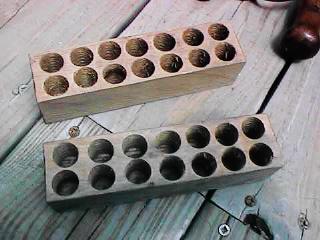
Here are two wooden cartridge blocks for the cavalry cartridge boxes. Don't know what they fit but they are drilled for around 50 caliber cartridges. Each hold 14 cartridges. Each one $35.00
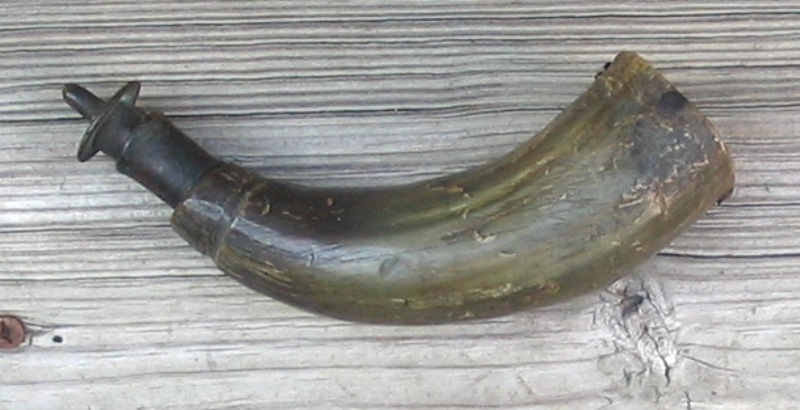
This is a great little pocket or priming powder horn. It measures about 6 1/4 inches on the outside of the horn curve not including the plug. The stopper end is octagonal in nature. Check out the pics! Nice little piece and right as rain! $65.00